


Therapy Tools
Coping with Grief Therapy Tool
Coping with Grief Therapy Tool
Heal yourself by processing emotions.
Couldn't load pickup availability
Digital Download: Journal PDF
Grief is deeply personal. It can feel overwhelming, confusing, and isolating—whether you’re mourning a loved one, a relationship, or a part of yourself. The Coping With Grief Therapy Tool offers education and practical exercises to help you process emotions, release guilt, and honor your loss at your own pace.
WHAT IT IS:
A structured therapy toolkit combining psychoeducation + five practical grief tools. It helps you understand what grief is, why it affects mind and body, and gives you gentle practices to move through loss with compassion.
HOW IT HELPS:
Each tool is designed to facilitate emotional expression and healing, helping you navigate the grieving process with greater resilience and understanding.
- Understand the stages and types of grief
- Normalize emotions - anger, guilt or relief
- Process feelings with guided prompts
- Create healthy rituals for letting go
- Reconnect with memories, meaningfully
- Build self-compassion, emotional resilience
WHAT YOU GET
Psychoeducation
- Understanding grief as a natural process
- Stages of grief (with psychological insights)
- Types of grief (anticipatory, disenfranchised)
- Emotional, physical, cognitive, social reaction
Therapy Tools
- Memory Map of Meaning
- The Grief Jar
- Grief Inventory & Let-Go Ritual
- Grief Sentence Completion
- Goodbye Letter
Format:
✔️ A5 size PDF therapy toolkit
✔️ Guided Worksheets & reflection pages (fillable/ printable)
Grief is not about forgetting—it’s about learning to live with love in a new way. Coping with grief therapy tool offers structure, space, and gentle guidance as you move through your healing journey.
HOW IT WORKS:
- Purchase: Secure your toolkit
- Instant Download: Save your digital copy
- Fill-in/Print Your PDF: Journal your inputs
- Reflect & practice with guided worksheets
- Choose your pace: use one or multiple tools
Got questions?
Frequently asked questions
Everything you need to know about the Coping with Grief Therapy Tool.
The psychoeducation section is designed to help you understand the psychological aspects of grief — why it affects you the way it does, how it shows up in your mind, body, and relationships, and the stages you may move through. Understanding grief is often the first step toward healing.
Yes — every tool comes with detailed guidelines on how to use it, along with worked examples so you know exactly what to do. You're never left figuring it out on your own.
This tool provides structured, therapist-designed prompts that guide you deeper than free writing. Each exercise is rooted in psychological technique — so you're not just expressing emotions, you're processing them in a clinically informed way.
No — and it's not designed to. It's a self-help resource that complements therapy beautifully, offering structured reflection and healing exercises you can do privately, at your own pace. If you're already seeing a therapist, you're welcome to use this alongside your sessions.
Not at all. Each tool is designed for independent use with clear guidelines. You may choose to discuss it with your therapist if you're seeing one, but it's fully usable on your own.
Following the order is recommended as each tool builds on the previous one. That said, you're free to pick the tool that feels most relevant to where you are right now. Healing isn't linear — use what you need, when you need it.
This tool is designed to help you reflect, express, and gently release grief — not to "fix" or eliminate it. Grief is a process, not a problem. What you'll gain is greater awareness, emotional tools, and a gentler relationship with your own healing journey.
That's completely okay. The tools are flexible — use what feels right today and revisit others when you're ready. There is no timeline for healing, and this tool doesn't ask you to rush.
Each tool includes a sample sheet with examples so you can see exactly how it works before applying it to your own situation. Just follow the example, then use the blank worksheets for your own reflections.
Yes — detailed navigation guidelines are included at the beginning of the book, covering both the psychoeducation and practical tools sections. Read through these first for the best experience.
After purchase, you'll receive an instant download link via email. Save the PDF to your device and you can access it anytime — no app or account needed.
Both work. The PDF is fillable, so you can type directly into it on your device. You can also print it if you prefer writing by hand — many people find the physical act of writing more grounding when processing emotions.
No. This tool supports grief from any significant loss — a relationship ending, a job, a health diagnosis, a life transition, or any part of yourself or your life you've had to let go of. Grief is grief, whatever the cause.
Anytime. Some find it helpful immediately after a loss; others come to it months or years later when emotions resurface. There is no "right time" — only your time.
No questions found in this category.
Still have questions? We're here to help.
Contact Happetive →Share

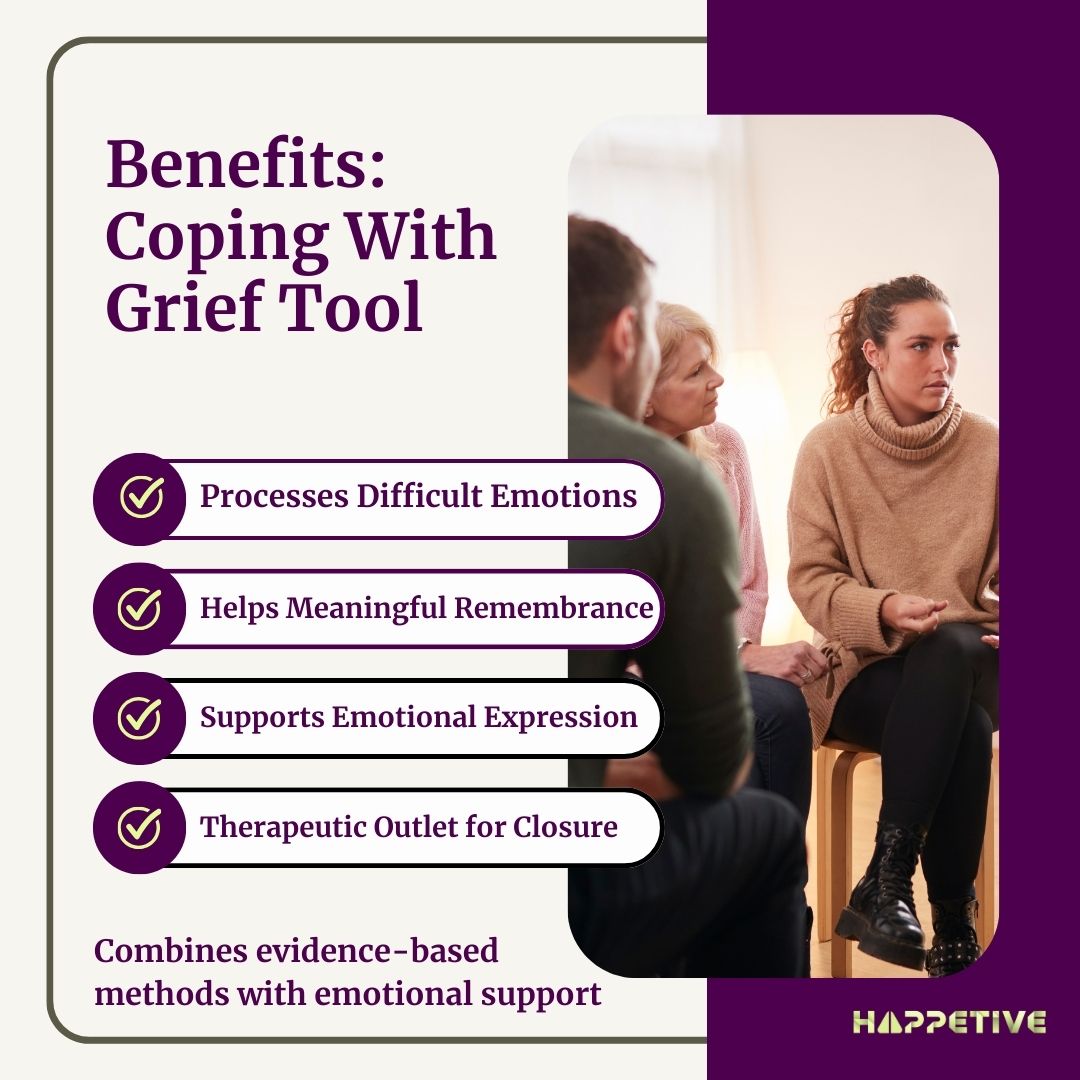



Heal yourself by processing emotions.
Coping with Grief Therapy Tool
TOOLS OVERVIEW
Here's more about the 5 impactful techniques to deal with and overcome grief:
- Memory Map of Meaning: Helps you ease the emotional weight of grief by expressing it safely
- The Grief Jar - Helps create emotional distance between your grief and your identity
- Grief Inventory Letting Go - Helps you to anchor yourself, be open and let go to heal yourself
- Grief Sentence Completion - Helps you make sense of conflicting or painful emotions
- Goodbye Letter - Helps you process your unresolved emotions and ease emotional tension
FREQUENTLY ASKED QUESTIONS (FAQs)
1. What is psychoeducation and how will it help me?
The psychoeducation section of Coping with Grief Therapy tool is designed to help you understand various psychological aspects of grief, why it affects you the way it does. It talks about the nature of grief and stages.
2. Are the therapy tools guided?
Yes every tool has detailed guidelines to use the tool along with relevant examples.
3. Are there any guidelines to help me navigate this therapy tool?
Yes you have detailed guidelines mentioned in the beginning of the book to help you navigate both the sections that is psychoeducation and practical tools.
4. Do I need to go through this book under the supervision of my therapist?
You may choose to discuss it with your therapist if you are already consulting one. Incase you are not seeing a therapist you can independently follow the tools. Each tool has detailed guidelines
5. Will I be able to be completely overcome my grief after completion of this therapy tool?
This therapy tool is designed to help you reflect, express and gently release grief. It offers you techniques and space to process grief in your own way.
6. How to use this therapy tool? Should I use the tools as per the order given in the book?
All the guidelines to use this tool effectively is mentioned in detail. You may choose to either follow the order or pick up a tool that seems relevant to you considering your current circumstances.
7. In order to practice, can I use the soft copy or do I need to download and print it?
The soft copy of the book is in editable format, however you can choose to download and print incase that seems comfortable.
8. How will I know how to use each tool?
Each tool has a sample sheet with examples given for your reference. Kindly go through the examples and then apply the tool using your own life situation.
9. Is this only for people grieving a death?
No. It also supports grief from breakups, job loss, illness, or any significant change.
10. How soon after a loss should I use this?
Anytime. Some use it immediately; others find it helpful months or years later when emotions resurface.
11. What makes this different from journaling on my own?
Coping with grief therapy tool provides structured, therapist-designed prompts that go deeper than free writing, helping you process emotions in a safe, guided way.
12. What if I’m not ready to let go yet?
That’s okay. These tools are flexible—use what feels right now and revisit others later. Healing has no timeline.
13. Can this replace therapy?
No. It’s a self-help resource that complements therapy, offering reflection and healing exercises you can do privately.

NOTE FROM OUR CO-FOUNDER
For years, Mental Health has been stigmatized in our society.
Expressing emotions like sadness or anxiety is often seen as weakness, hindering open discussions and access to mental health resources.
HAPPETIVE BELIEVES IN BREAKING THE TABOO AROUND MENTAL HEALTH.
We offer curated Mental Wellbeing Products designed by Mental Health Experts, Psychologists & Business leaders to support Everyone's Mental Wellbeing Journey.
Our tools are an amalgamation of various techniques from the field of Psychology and Spirituality. [Backed by Scientific Approach in the field of Mental Health]
Rhea Doshi (Co-Founder & CEO) is India's leading Counselling Psychologists, Human Resources Leader, Meditation Expert & a Certified Healer.